Saturday, April 27, 2024

Film of the Week: Late Night with the Devil


The Satanic Panic of the 70s was an underlying symptom of the social and political upheaval of the era, as America's transition from the New Deal era to that of the neoliberal, centrist political system began in full force. The shining smiley-face vision of America had fully melted away, the era of "love thy neighbor" was dead, in its place was a cultural attitude of paranoia. And with this paranoia came the opportunity for those who were callous enough to exploit attitudes and powers beyond their control.

The exploiters are the focus of Late Night with the Devil, the indie horror film framed as a collection of footage from the infamous Halloween episode of Night Owls with Jack Delroy, a 70s late show and apparent rival to the likes of Johnny Carson. A mix of Ghostwatch (a real-time broadcast beset by the supernatural) and Gonjiam: Haunted Asylum (frequent behind-the-scenes footage that depicts the slow, steady breakdown of its participants), Late Night is all about perceptions of what is real and what is not and how people are willing to exploit that for fame, fortune, or a chance to get their name out. For the most part, it works, crafting a unique horror experience that compels its viewers, even as it goes off the rails slightly in its climax. Much of the credit for this is the excellent costume and set design, which faithfully recreates the look of the era, from the sliding door sets to the garish sideburns and bowlcuts of its various guests. It makes the show, largely, feel lived in, something that audiences have watched for years rather than just a cheap imitation. 

The 70s talk show aesthetic is so faithfully recreated that the Cairnes siblings willingness to subvert and distort it makes it feel like a jarring intrusion on what should be a safe space, perpetually ratcheting up tension as the show progresses closer and closer to its climax. Of course, this also makes the film's usage of AI art even more inexplicable, a lazy shortcut that breaks immersion every time it "graces" the screen and reflects poorly in an era when artists more than ever need solidarity.

The cast, similarly, is immensely game, playing a mixture of skeptics, charlatans, and professionals confronted with a horror that, if real, threatens to spiral beyond their control. David Dastmalchian in particular carries it, selling Delroy as an affable, troubled figure whose true nature, a mix of grief and desperation, bubbles up more and more with every passing minute. It's a character whose motivations are more implied than truly shown, and he sells it well, playing with audience perception and sympathy even as the "truth" is revealed.

It's the idea of perception and how to weaponize it that makes the film so effective. It's characters, intentionally, are vaguely written, their exact motivations and relationships, such as Delroy's relationship with June Ross-Mitchell (Laura Gordon), the caretaker/psychiatrist of Lilly (Ingrid Torelli), or the exact circumstances of his apparent Faustian bargan for fame and fortune, are left up to hints and audience interpetation. Effectively, it leaves us as viewers to the show, only lucky enough to see what they show us. This playing with the medium helps keep a sense of immersion, from the strange audio/visual glitches throughout to a particularly memorable sequence in which the audience witnesses a hypnosis, only to in turn be hypnotized themselves.

Even a move that should be immersion-breaking—a shift to a modern, high-definition style during the film's climax—doesn't break things too much. It's jarring, but in the chaos of the film's final twenty minutes, a delightfully practical bloodbath where the tightrope of tension and uncertainty finally snaps, it adds to the overwhelming feeling of witnessing something that has gone completely out of control. It's this creativity, this "throw at the wall and see what it sticks" mentality, that makes Late Night with the Devil such a treat and a worthy follow-up to its clear influences.

Saturday, April 13, 2024

Film of the Week: The Killer

John Woo's The Killer, a seminal action masterpiece from which much of the modern genre owes its influence, opens on a quiet, solemn note: Ah Jong (Chow Yun-Fat) sitting in a church, quiet and contemplative. It's a quiet opening, but an effective one that is violently contrasted with the next scene, as Ah Jong departs on a hit, easily eliminating his targets but leaving Jennie (Sally Yeh), a kind nightclub singer, partially blind in the crossfire. From the get-go, Woo manages to connect the dots of one of the film's central ideas, and arguably it's most compelling: violence, no matter how effective or cool, wears on the soul, it's inescapable grasp refusing to let anyone go.

Throughout each of The Killer's kinetic, exhilarating shootouts, there's a sense of weight and consequences to it that make the action far from mindless. Jennie's blinding. A group of hitmen critically injure a little girl in their effort to kill Ah Jong. Detective Li Ying (Danny Lee), Ah Jong's foil, is introduced as he rashly kills a suspect in public, only to frighten his hostage into a fatal heart attack. These actions, the kind lesser action movies wouldn't think on, take a real toll, both physical and emotional, on our heroes and the people caught up in their conflicts, from the short-lived supporting cast to civilians who have the fatal misfortune of being in the wrong place at the wrong time. It's an often shocking amount of heart from Woo for me, someone more familiar with his more explosive, over-the-top American work in the form of Face/Off (a classic) and Mission Impossible 2 (the worst Mission Impossible). And yet, it's this heart that makes the movie and its characters fascinatingly compelling. The Killer is just as willing to sit and let its characters breathe and ponder to themselves as it is to let them blast their way out of a beachhouse.

And man, the gunfights really rip. Goons are torn apart and sent flying by the force of the rounds blasted through their bodies in a glorious ballet of tightly coordinated chaos, our heroes pumping out endless rounds as they fight against wave after wave of foes. Even after witnessing decades of its derivatives, the work of John Woo remains fresh and a blast to watch. It even understands that any action movie worth its salt gives you characters worth rooting for, completely nailing its unlikely buddy cop aesthetic with the excellent chemistry between Fat and Lee, a delightful pairing of two men whose philosophies and mutual respect bring them together. As the duo's story moves to its violent conclusion, you find yourself pulled on a genuine emotional rollercoaster, equal parts exhilarating and heartbreaking.

It's the film's conclusion, I think, that gives it the most weight, as Woo brings his reflection on violence home with a bang. The church, once a symbol of serenity and escape from violence, is destroyed, our hero loses his life, and his newfound friend loses everything in search of vengeance. It's a shocking, brutal close—the final fate of a blinded Ah Jong crying out for Jennie as he dies just inches from her a genuinely heartbreaking sequence. It's gutsy, bold, and it sticks with you just as much as any of the glorious, influential action.

Saturday, April 6, 2024

Film of the Week: Inside Man

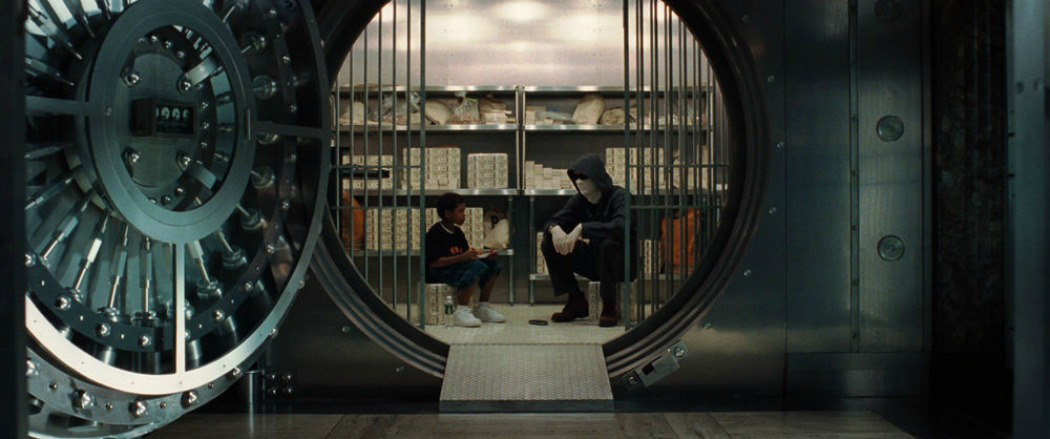
Inside Man is the peak example of getting an auteur director to do the kind of project often saved for journeymen. What could've, on paper, been a standard crime thriller is, in the hands of Spike Lee, turned into a clever, tense caper full of great performances and biting social commentary that is just a blast to watch. Another thing that makes Inside Man such an interesting watch is that it simply doesn't feel like a movie you make anymore. Mid-budgeted crime thrillers of this nature used to be a dime a dozen; now very rarely do they grace our silver screens. (Perhaps if more of you had seen Steve McQueen's excellent Widows, things would be different, but alas.) It's a film very much of its era, but rather than feel dated, it gives it a sense of being tied into its cultural moment that the best works of Spike Lee often do. NYPD officers shake down a Sikh witness, his protests falling on the unsympathetic ears of a diverse duo of detectives, while the film's true villain is none other than a bank founder trying to cover his ties to Nazi Germany. It's efforts at social commentary, rather than distracting, instead enhance the narrative, creating something angrier and more intriguing than the usual genre fare.

It helps, of course, that it's also a very entertaining watch. Lee's direction propels the film forward, with clever usage of cuts and shifts in perspective being deployed to leave the audience guessing without ever feeling lied to. A particular favorite is the film's interrogation scenes, narrative flash-forwards that swing from humorous to quietly revealing, sewing seeds of paranoia in the modern-day scene. It's incredibly confident in how it chooses to tell a story, even down to its usage of humor, which could've easily fallen flat but instead breaks the tension and makes the characters feel real and believable. Without spoiling, I'll confidently say this has one of the funniest needle drops of all time.

Another major point in Inside Man's favor? The absolutely stacked cast firing on all cylinders. Denzel Washington, one of our greatest leading men, plays Detective Frazier, a put-upon hostage negotiator, as a witty everyman who is just clever enough that his battle of wits with Dalton Russell (Clive Owen) never feels one-sided. Owen, in particular, is excellent, swinging from affable and witty to genuinely terrifying at the drop of a hat. One moment, he savagely beats a hostage for lying to him. The next? Quietly musing on the nature of violent videogames with a young boy unfortunate enough to be caught up in the robbery, a clever parallel is drawn between him and how the detectives similarly shift attitudes depending on the suspects they're interrogating.

In many ways, that idea, how clever people weaponize personality for their own ends, is the throughline of much of the film. From how the detectives switch from affable to harsh, to Dalton's willingness to dance between detached humor to seemingly casual cruelty, to Arthur Case's (Christopher Plummer) usage of charity to hide the bloodsoaked ways in which he acquired his wealth, Inside Man ponders the faces we wear to get the job done and how much, if any of it, is the real us. In this way, none of our characters are very different; all charismatic people who weaponize that charisma for their own means in a world where the lines of morality aren't quite so clear.

Saturday, March 30, 2024

Film of the Week: The Zone of Interest

What does it take for one to become desensitized to some of the worst horrors mankind can inflict upon others? Can someone become so utterly tuned out of them that the screams of the dying become simple background noise? As we see on our own news every day as a genocide is committed with our support and funding, it is far easier than one would hope.

It's this conflict that drives The Zone of Interest, the Academy Award-winning latest from Jonathan Glazer, director of Under the Skin and Sexy Beast. In classic Glazer fashion, Zone of Interest is another new turn from him, an almost minimalist domestic drama against the backdrop of the Holocaust. The film focuses on Rudolf Höss, commandant of Auschwitz, and his family as they go about their lives in apparent domestic bliss in a home that is directly next to the camp itself. Revealed almost immediately with a cut to the smokestacks towering over the walls surrounding the family's home, the camp hangs like a sword over every moment of the film. It's this contrast of idyllic family life against the backdrop of atrocity that serves as the film's driving force. Rather than attempt to moralize or exploit the suffering for visual horror, Glazer repeatedly and actively keeps the Holocaust in the background to an unnerving, spine-chilling effect, a clear effort to show the dehumanization that made it all possible in the first place. The screams and sobs of the prisoners quietly echo through the background, architects explain the operation of gas chambers the way one would explain the operation of a cash register to a new employee, and in one particularly grim moment, Höss fishes a jawbone from the river, his immediate concern becoming the health of his children playing upstream rather than the thought of how many had to perish for the river to become that polluted in the first place.

Zone of Interest's sound design pulled an upset win over Oppenheimer at the Oscars, and it's hard not to see why. Glazer wields sound incredibly carefully, almost entirely doing away with a score while keeping the background noise at just the right level to unnerve but not distract. It sells the idea of a Höss family as people who have attuned themselves to horror, content to profit off it with stolen clothes and pilfered gold teeth while pushing the emotional weight of it to the back of their minds. But, try as they might, their complicity is inescapable, and their attempts to avoid it simply rot their souls. Höss fights to stop himself from vomiting as he prepares to oversee an operation that will kill 700,000 Hungarian Jews, while his wife, Hedwig, fights against any attempt to take away her newfound luxury, from urging Hoss to keep their family at Auschwitz while he leaves for a promotion to angrily burning a letter left by her horrified mother, who left in the dead of night after visiting the family.

This cold detachment is perfectly played by both Christian Friedel and Sandra Hüller, who, respectively, play Rudolf and Hedwig. Friedel plays Hoss with a sense of bueracratic pride and stoicism, his workmanlike management of the camp contrasting against the acts committed within it, from his calm oversight of a line of desperate prisoners being led off a train to his address of violent rapes of prisoners by guards being framed as a warning not to "damage the flowers", while Hüller is monstrous in her portrayal of Hedwig. Hedwig is immensely stubborn and demanding, lashing out at anyone who would attempt to pierce the picture-perfect world she has crafted in an effort to escape from the guilt of her knowledge of what that world is built off of.

But the guilt is inescapable, and the film's final moments, a jarring vision of the future (our present) of Auchwitz, seem to show both Rudolf and us, the audience, that history is the ultimate judge. While Rudolf and Hedwig are both assigned to the dustbin of history, their legacies little more than obscure accomplices to mass murder, that leaves us. As the credits roll, The Zone of Interest sits with you, leaving you to wonder how we will be looked back upon, even as we assure ourselves that we would never act as they did.


Saturday, March 23, 2024

Film of the Week: Daddy Longlegs


The career of the Safdie brothers, the auteur duo behind Good Time and Uncut Gems, is often focused on getting their audience to root for characters that are largely undeserving of sympathy. From sociopathic criminals to degenerate gamblers, the brothers (and the very talented actors portraying these parts) manage to make their antiheroes often feel like real, living people, enabling them to walk a tightrope when it comes to capturing the audience's attention and empathy.

Daddy Longlegs, the first film in which the duo worked together as directors, is no different. Even with lower stakes, a slice-of-life depiction of a single dad enjoying his two weeks of custody with his kids rather than the nerve-wracking crime thrillers that make up the Safdies later work, the film bears much of their trademark tactics for building tension, from the grainy, shaky camerawork to the often overwhelming (complimentary) sound design employed throughout it's chaotic conversations. It gives Daddy Longlegs the energy of the audience stumbling upon a particularly upsetting home movie, one where the happy memories are instead a series of agonizingly poor decisions that play out like a car crash in slow motion. 

This is aided by the excellent performance of Ronald Bronstein, better known as the duo's cinematographer, as Lenny. Lenny is twitchy, ill-tempered, and increasingly shortsighted, struggling to find some level of meaning for himself outside of his sons, only to repeatedly realize he has little else. Even at his nastiest and most bumbling, Lenny never feels like a caricature, and it makes his screw-ups often agonizing to witness.

In a particularly standout sequence, Lenny drugs his sons to ensure they sleep through his shift as a projectionist, only to realize he wildly overdosed them, effectively putting them into a days-long sleep. His reaction? To halfheartedly check in on them while he dicks around in the city, too self-centered to directly face the consequences of his actions but not sociopathic enough to completely ignore them. Bronstein plays Lenny as a man on the cusp of self-realization, but unable to go through with it, leaving someone who lashes out at the world to make up for it. From his awkward, flailing lies to everyone around him to his treatment of his on-off girlfriend Leni (Elenore Hendricks), much of Lenny's arc is him realizing his mistakes mere moments after making them. It's frustratingly relatable, and it makes Lenny's actions in the film's final moments feel like a natural conclusion to his selfish nature rather than a cartoonish turn that a lesser story could've turned it into.

And good god, the ending. In a twist clearly inspired by the works of Abel Ferrera, the duo's self-admitted inspiration to the point that he has a particularly "fun" cameo as a foul-mouthed scalper turned armed robber, Lenny chooses to simply take the boys for himself, abruptly packing his things and taking them to parts unknown, a kidnapping committed out of a selfish desire for happiness. Rather than pull the punch, having Lenny's plan thwarted or some horrible karmic fate befall him, the film instead ends on an uncertain note, a static shot of a tram pulling away as Lenny and his sons seemingly get away, their ultimate fates uncertain. It's a fitting end for a work that treats its audience as observers. Our glimpse into Lenny's life is over, and we can only watch and hope for the best as he leaves us behind.