Sunday, October 6, 2024
Film of the Week: Ghostwatch
Sunday, September 29, 2024
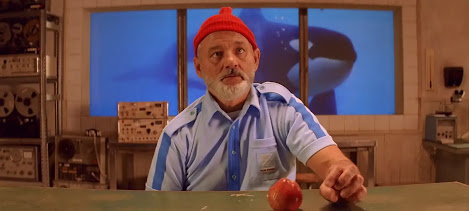
Film of the Week: The Life Aquatic with Steve Zissou
If there's one recurring idea that permeates throughout the work of Wes Anderson, it's grief and the endless struggle of learning to live with it. There's always a sense of bittersweetness to his best work, which is consistently very good, and in how it approaches this struggle. More than any filmmaker, I think, Anderson's filmography is fun to go through because you watch his view on this idea grow and mature, becoming more nuanced but no less heartfelt in his unique, subtle ways. It's also fun to watch through because as he grows in maturity, he also grows in confidence and ambition, his work becoming bigger, more elaborate and with an increasingly talented ensemble in tow. The Life Aquatic with Steve Zissou, his fourth film and the last work of his to be distributed by Disney until their buy-out of 20th Century Fox, represents Anderson's growth into one of Hollywood's most visually fascinating directors without losing the quietly sentimental spark that made him so unique.
A send-up of both the late oceanographer Jacques Costeau and of pulpy adventure stories like 20,000 Leagues Under the Seas and Moby Dick, Life Aquatic is often incredibly pleasing to look at. The film's primary setting, the Belafonte, is an elaborately designed set masquerading as the ship of the titular Steve Zissou (Bill Murray, who has honed his talent for playing morose sad sacks with a heart of gold to science at this point), and Anderson expertly introduces us to it with a loving pan through the cramped confines of the ship. We see every room, every detail, from the side, giving us an immediate sense of scale and where, exactly, everything and everyone is. Many of the film's fantastical creatures, witnessed in Steve's expeditions, are rendered through claymation, which contributes to the fantastical feel of the film. It's quickly clear that this is something bigger, a more heightened reality than Anderson's prior work, which makes the very real emotions at play hit that much harder.
At it's heart, Life Aquatic is a story about loss and learning to live with it, and that no amount of control or micro-management can do a thing about the random cruelties that life can dish out. Steve, an eccentric if charismatic oceanographer, begins the film on a quest for vengeance, hunting the rare jaguar shark that, by Steve's own words, "devoured" his lifelong best friend Esteban. While nowhere near Captain Ahab's level of fanaticism, it becomes clear that Steve's obsession with hunting the creature, potentially the only one of it's kind, is a greater attempt to lash out at the world for taking his friend from him, as he crudely announces his intention to blow up the shark with dynamite. Much like Ahab, however, Zissou drags along a crew heavily devoted to him, from the affection-starved, childishly petty first mate Klaus (Willem Dafoe) to the quiet, musically talented safety expert Pele (Seu Jeorge, who provides a series of beautiful David Bowie covers) to snarky, rarely clothed script supervisor Anne-Marie Sakowitz (Robyn Cohen), and several newcomers, like Steve's apparent son Ned Plimpton (Owen Wilson, very quietly reminding me of his underrated talents as a leading man) and hard-hitting, pregnant reporter Jane Winslett-Richardsson (Cate Blanchett), who quickly becomes an object of mutual affection for the coarse Steve and the more gentle Ned.
The film is a proper adventure romp, if a more subversive one than the traditional fare, depicting the struggles of it's eccentric, deeply dysfunctional crew in a series of mishaps. A clash with pirates is portrayed as less a tense hostage situation and more of an exasperating road bump as two equally incompetent crews run afoul of each other, while Steve's recurring rivalry with the wealthier, more suave Alistair Hennessey (Jeff Goldblum, because who else?) serves as host to a series of great set-pieces (the impromptu heist of a Hennessey laboratory got a good laugh out of me with the spiteful bluntness of it while the crew's rescue of Hennessey from the pirates makes for a surprisingly tense action sequence) with a strong emotional pay-off as the two bond over a shared experience. The cast, a mix of Anderson's usual actors and newer players who would become bigger figures down the line, have a very lived-in chemistry. They bicker, they grow closer, and the various personalities clash in both expected and unexpected ways, feeling like a very genuine found family by the film's end.
Of course, the good times can never last, and it's not a Wes Anderson film without a suitably brutal gut punch. In this case, it's Steve's pursuit of revenge for his best friend claiming the life of another loved one, as his reckless attitude and poor care for equipment causes an accident that kills Ned. It's a devastating moment, and the film's decision to first raise our hopes (Steve finds Ned floating amidst the wreckage) before crushing them (Anderson brilliantly bobbing the camera above and below the water as it gets more and more red) and then ultimately letting us sit in our grief speaks to the very real feelings that we've found ourselves developing for this larger than life characters. The message is clear: Esteban is gone, and Steve's refusal to admit that he can't bring him back has claimed Ned as well. It's in this moment that Steve, like many of Anderson's best protagonists, lets go of his grief, letting those he's lost live in heart by choosing to embrace life.
This is represented by the quietly profound encounter with the jaguar shark itself, a beautifully designed creature that swims around the submersible the crew is packed into. Face to face with the beast he's hated, Steve half-heartedly admits to being out of dynamite, and simply washes it circle them before vanishing into the depths. Eyes brimming with tears, he whispers, "I wonder if it remembers me?" While we get no answer, the point is clear: change is impersonal, uncaring as to whether or not you're "important", and while tragedy is destined to strike everyone, what matters is how you choose to live in the aftermath of it.
Sunday, September 8, 2024
Film of the Week: Milk and Serial
Sunday, September 1, 2024
Film of the Week: Duel
Steven Spielberg is one of those filmmakers that, despite being a multi-Academy Award winner whose helmed some of the most successful and critically acclaimed films of all time, I feel can be genuinely underappreciated for the sheer talent and inspiration behind the camera. For all the criticisms that he's a sentimental director, in love with Americana and old-school style, Spielberg is also a deeply creative, often brilliant director, so good at it that he often makes it look easy, as James Mangold found out the hard way in making Indiana Jones and the Dial of Destiny, a film I generally liked but was a far cry from the original trilogy. This was very evident to me in the making of Duel, his directorial debut from when he was a mere 25 years old. A low-budget tv movie, shot at breakneck speeds and cut together a mere matter of days before it's premiere, Duel is a fascinating peek into the early days of one of cinema's greats, tense and surprisingly character-driven in it's depiction of road rage gone bad.
Shot on a low budget of $450,000, Duel is considerably minimalist, shot almost entirely on the highways and deserts of California. There's only one physical location, a diner that David Mann (Dennis Weaver) crashes outside of and spends a fair amount of time contemplating the next move in his battle of wits with a seemingly psychotic, unseen truck driver. This adds to the film's constant sense of paranoia and isolation, as Mann, a stressed businessman on a last-minute trip out of Los Angeles, is completely alone, unsure of who to trust and where he can even go to avoid the wrath of the driver. Weaver, chosen by Spielberg due to his role in Touch of Evil, is excellent as Mann, an embattled everyman whose frustration and resentment boils over as he feels the walls close in around him, while Spielberg's decision to leave the driver as a faceless entity pays off very well. We as an audience are left to decipher the exact motives of the driver, who goes from chasing down Mann at 90 MPH one moment to helping a bus full of kids the next. Is it casual cruelty that drives the pursuit? Misplaced vengeance at a driver who cut him off? It's up to us.
The true antagonist, in a way, is the driver's truck, a worn-down Peterbilt 281 tanker hauling some form of hazardous material. The Peterbilt, a rusted, roadworn tanker with a set of license plates across it's front like a Predator's belt of skulls, serves as a looming threat, it's mere appearance (even when parked) signaling very clear danger, and it's final, dinosaur-like roar as it's destroyed makes the "vehicle as monster" message very clear. Making this a battle against a faceless threat lets us sit with Mann, his internal monologues and frantic, anxious expressions telling much of the story without saying much at all.
And of course, Spielberg's direction goes a long way. The truck is presented as death on wheels, hurtling across the road while looming large in every shot it's in, and in a particularly tense set-piece, it appears almost out of thin air from off-frame to try and run over Mann as he attempts to call for help in the only phone booth for miles. Duel often feels claustrophobic, the miles of open road lonely and hostile rather than particularly freeing, and even when Mann is around other people, it's little comfort as he attempts to surmise the identity of his unknown attacker, the camera at one point closing in on his face as he scans the room, looking for any clues that could help him. The tension becomes suffocating at points, and the final shot, a lonely Mann sitting on a hillside as the sun sets, gives little comfort as we realize just how exhausting this fight for survival, forced on him just because he was in the wrong place at the right time, has been.
Duel is a fascinating piece of cinema history and just a damn good movie overall. Spielberg would go on to do bigger and better things, but it's easy to see why this is one he often revisits. Without it, one of cinema's great auteurs might not have ever been able to explode on the scene. It's like watching the expert planting of seeds: in time, something beautiful will grow from it.
Sunday, August 11, 2024
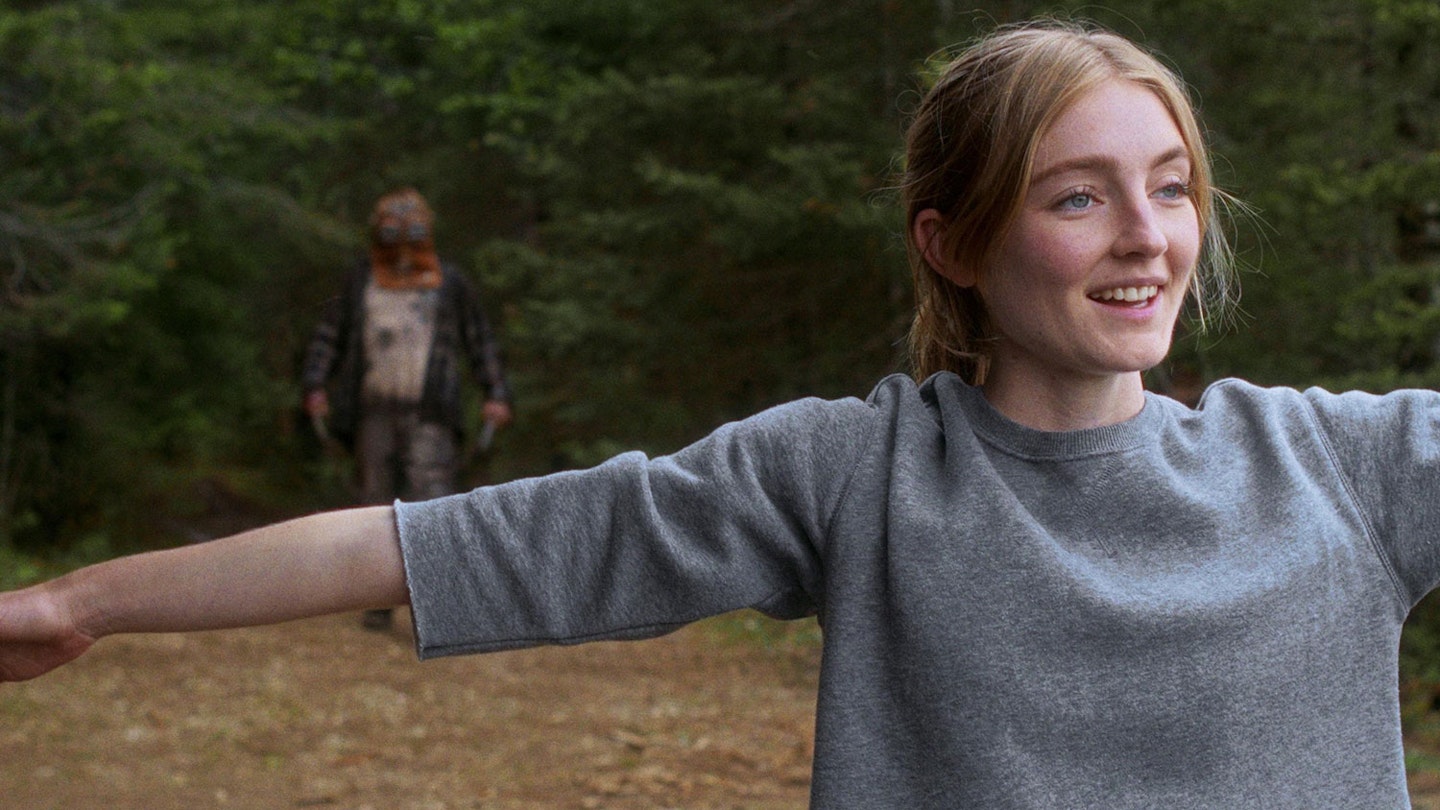
Film of the Week: In A Violent Nature
It's not to say there isn't fun to be had here. Johnny's continued abuse of a corpse as a means of opening doors and windows is genuinely hilarious, while the film's most interesting concept is the quiet reveal that it's a sequel to a previous rampage of Johnny's, as a grizzled park ranger (Reece Presley) explains to two of our survivors. The film often works best when it's committed to the idea of showing us the things that horror movies decide not to show. Johnny's treks, a deliberate subversion of the idea of a slasher simply teleporting to the next place, through the wilderness are strangely peaceful, as director Chris Nash and cinematographer Pierce Derks are content to just let us soak in the gorgeous views while playing with lighting just well enough to make the film's nighttime scenes pop out.
And, of course, if you come to this looking for a slasher film, you'll have a fun time. The film's various kills are suitably gory and fairly entertaining in their execution, while Nash wisely commits to a more mundane tone as a contrast. There's nothing in the way of music as Johnny tears his way through the cast, nor are there cheap jumpscares as we see it from the killer's perspective. They're simply brutal and to the point, then on to the next trek. None of it feels personal or particularly passionate, just Johnny eliminating an annoyance on his journey for his late mother's necklace. A particular favorite is Johnny's violent killing of the aforementioned ranger, a slow affair as Johnny cripples the man, drags his body to a wood shed, then slowly but surely dismembers him with a log splitter. Of all the film's kills, it's the one most fitting of its premise, and the often jarring contrast between the general serenity of much of the film and the comical absurdity of its deaths is a lot of fun to behold.
As a slasher, it's entertaining, but for a film that loudly prides itself on playing with perspective, it doesn't do too much with it. The shift in perspective, theoretically, should subvert our expectations and sympathies, but we learn frustratingly little about Johnny over the course of his adventure. A single flashback that establishes the importance of his mother's necklace is our only real hint to his motivation, while a scene of him playing quietly with a toy car is suitably interesting, but the "why" of him is left up to us with little in the way of clues to put together. The film suggests some sort of explanation near the end in the form of a long-winded story told by a good samaritan (Lauren Taylor) about how the isolating effect of nature can make anyone feral, but it's hardly a full rationalization of the various killing sprees. Without a properly subversive answer, Johnny is little different from the slashers he serves as a parody of, and his brutal, dreamlike murders lack a proper impact without a "why.".
In A Violent Nature is an interesting experiment—a slasher from its killer's perspective—that doesn't quite hit the heights that its premise could. There is, undeniably, a real talent on display here, as Nash frames events beautifully and comes very close to selling the idea in its wonderfully brutal kills, but it's something that maybe needed a little more to go from "good" to "great". A sequel has been announced that I will happily be seated for, so perhaps the second (or third, if we stick to continuity) time will be a charm.